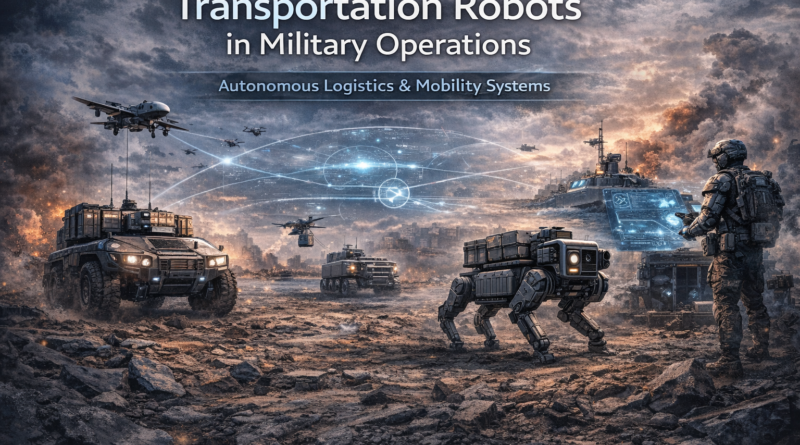
Transportation Robots
Transportation Robots in Military Operations: Autonomous Logistics and Mobility Systems
Introduction
Transportation and logistics have always been decisive factors in military operations. The ability to move supplies, equipment, and personnel reliably often determines operational tempo and endurance. As modern battlefields become more dispersed, contested, and sensor-rich, traditional logistics models face growing challenges.
Transportation robots—autonomous or semi-autonomous systems designed to move cargo and support mobility—are emerging as a critical component of future military logistics. Rather than replacing human logisticians, these systems aim to reduce risk, extend reach, and sustain operations under increasingly complex conditions.
What Are Military Transportation Robots?
Military transportation robots are unmanned systems designed to transport supplies, equipment, or payloads across land, air, or maritime environments with limited or no direct human control.
They typically include:
- Unmanned Ground Vehicles (UGVs) for land logistics
- Unmanned Aerial Vehicles (UAVs) for aerial resupply
- Unmanned Surface and Underwater Vehicles (USVs/UUVs) for maritime transport
Unlike combat robots, transportation robots prioritize reliability, autonomy under constraints, and operational safety over speed or lethality.
Why Transportation Robots Matter
Modern military operations face persistent logistics challenges:
- Long and vulnerable supply lines
- High risk to personnel during resupply missions
- Difficult terrain and urban congestion
- Contested environments with degraded communications
Transportation robots address these challenges by enabling:
- Reduced exposure of human drivers and crews
- Continuous or persistent logistics support
- Distributed and flexible resupply models
- Operations in environments unsuitable for manned vehicles
In effect, they shift logistics from a manpower-intensive activity toward a technology-enabled capability.
Key Types of Transportation Robots
Unmanned Ground Transportation Robots
Ground-based transportation robots are among the most mature logistics systems in military robotics. Often wheeled or tracked, these UGVs can operate as robotic “mules” or autonomous cargo carriers.
Typical roles include:
- Ammunition and supply transport
- Casualty evacuation support
- Equipment movement in urban or rough terrain
These systems are particularly valuable in forward areas where human drivers would face high risk.
Aerial Logistics Robots
Unmanned aerial logistics platforms provide rapid, flexible resupply over difficult terrain or obstructed routes.
Common use cases:
- Delivering medical supplies to isolated units
- Emergency resupply in contested zones
- Time-critical payload transport
While payload capacity remains limited compared to ground systems, aerial transportation robots excel in speed and accessibility.
Maritime Transportation Robots
In maritime environments, autonomous surface and underwater vehicles support logistics by:
- Transporting supplies between ships or shore
- Supporting amphibious operations
- Operating in ports or coastal areas with limited access
Maritime transportation robots contribute to distributed naval logistics, reducing dependence on large, centralized vessels.
Autonomy and Navigation Challenges
Transportation robots must navigate complex, dynamic environments. Unlike controlled test settings, military logistics routes involve:
- Unpredictable obstacles
- Civilian presence
- GPS-denied or degraded conditions
As a result, most systems rely on graded autonomy:
- Autonomous navigation under normal conditions
- Human supervision or intervention when uncertainty increases
This balance reflects the practical limits of autonomy in real-world military operations.
Integration with Command and Control Systems
Transportation robots do not operate independently. Their effectiveness depends on integration with broader command and control (C2) and logistics management systems.
Key integration requirements include:
- Route planning and task assignment
- Real-time status and health monitoring
- Coordination with manned units and other robots
Without system-level integration, autonomous transport adds complexity rather than capability.
Operational Benefits
When properly integrated, transportation robots offer several operational advantages:
- Risk reduction: Fewer personnel exposed to ambushes and hazards
- Operational endurance: Sustained resupply without fatigue
- Flexibility: Adaptive routing and task reassignment
- Scalability: Multiple autonomous assets supporting distributed units
These benefits align with broader trends toward distributed and resilient force structures.
Limitations and Constraints
Despite their promise, transportation robots face real limitations:
- Payload and endurance constraints
- Dependence on reliable energy sources
- Vulnerability to electronic warfare
- Maintenance and sustainment challenges
Recognizing these constraints is essential to realistic deployment and expectation management.
Transportation Robots in Future Warfare
In future warfare, logistics is expected to be more contested and less centralized. Transportation robots support emerging concepts such as:
- Distributed operations
- Attritable logistics assets
- Human–machine teaming in sustainment roles
Rather than a single revolutionary leap, progress in transportation robotics will likely be incremental, driven by operational experimentation and adaptation.
Strategic and Organizational Implications
Adopting transportation robots requires changes beyond technology:
- Training personnel to supervise autonomous logistics
- Adapting doctrine to mixed manned–unmanned convoys
- Updating procurement models to account for software evolution
These organizational factors often determine success more than hardware performance.
Conclusion
Transportation robots represent a practical and impactful application of military robotics. By reducing risk, extending operational reach, and enabling flexible logistics, they address some of the most persistent challenges in military operations.
Their true value lies not in replacing traditional logistics, but in augmenting human capability through autonomous support systems. As militaries continue to adapt to complex and contested environments, transportation robots will play an increasingly central role in sustaining future operations.