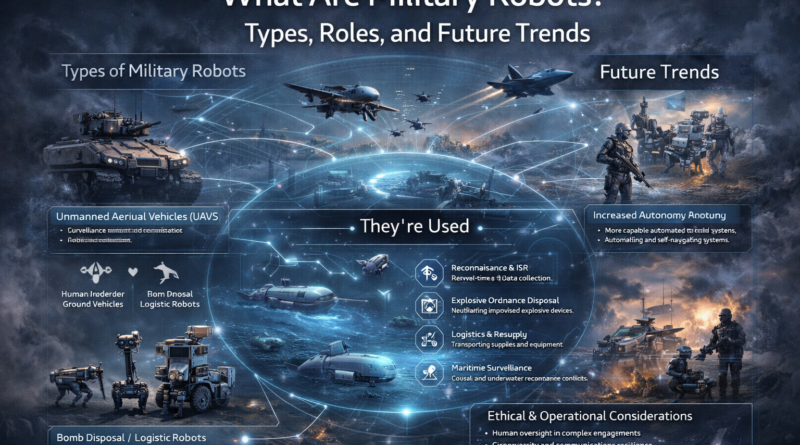
What Are Military Robots? Types, Roles, and Future Trends
Military robots are increasingly shaping modern defense operations and battlefield concepts. Once limited to simple remote-control units, military robotics today encompasses a wide array of unmanned systems, sensors, and autonomous technologies designed to reduce risk, expand operational reach, and enhance decision-making across land, air, and maritime domains. These systems range from ground robots that inspect hazardous environments to aerial drones that provide persistent reconnaissance and emerging autonomous units that collaborate with human forces.
What Defines a Military Robot?
A military robot is a machine engineered to perform tasks typically undertaken by humans in defense contexts—from reconnaissance and logistical support to combat support—in environments that are dangerous, remote, or beyond human reach. These systems often integrate sensors, communications, and varying degrees of autonomy to operate either remotely or semi-autonomously.
Unlike industrial or commercial robots designed for structured environments (like manufacturing), military robots must operate under uncertain conditions, contested communications, and dynamic tactical scenarios. Their design reflects the need for durability, adaptability, and reliable performance in complex terrains.
Primary Types of Military Robots
Military robotics is broadly categorized by operational domain and task focus. The following are among the most commonly recognized classes:
Unmanned Ground Vehicles (UGVs)
Unmanned Ground Vehicles are robotic platforms that operate on land to perform missions such as reconnaissance, route clearance, explosive ordnance disposal (EOD), and support functions like resupply. These systems extend human capability into high-risk environments without exposing soldiers to direct danger.
Examples of UGV roles include:
- Detecting and neutralizing improvised explosive devices
- Conducting urban surveillance
- Transporting equipment in hazardous zones These vehicles range from compact remote-controlled units to larger autonomous systems capable of more complex navigation and task execution.
Unmanned Aerial Vehicles (UAVs)
Unmanned Aerial Vehicles—commonly known as drones—are among the most visible military robots today. They provide persistent aerial surveillance, target tracking, and communications relay, often far beyond the line of sight.
Key capabilities include:
- Wide-area reconnaissance
- High-resolution imagery and sensor data
- Support for precision strikes (when authorized)
Their versatility has made them indispensable in both peacetime patrol and active conflict zones.
Unmanned Underwater and Surface Vehicles (UUVs / USVs)
In the maritime domain, Unmanned Underwater Vehicles (UUVs) and Unmanned Surface Vehicles (USVs) perform missions such as mine detection, hydrographic mapping, port security, and coastal surveillance. These robotic systems navigate submerged or surface waters to gather data and conduct tasks that would otherwise be high risk for human crews.
Maritime robotic platforms are increasingly integrated into broader naval operations, providing persistent presence and sensor coverage in contested sea lanes.
Specialized and Emerging Robotic Categories
Beyond the basic domain classifications, several specialized robotic systems are gaining attention:
Bomb Disposal and EOD Robots
These robots are tailored to locate, analyze, and neutralize explosive threats—especially improvised explosive devices (IEDs). They employ rugged sensors and manipulators to minimize risk to personnel.
Robotic “Mules” and Logistic Support Units
Quadrupedal or wheeled robots can carry supplies, ammunition, or critical equipment across difficult terrain, acting as autonomous logistic assistants.
Humanoid and Legged Robots (Emerging)
Some research and prototyping efforts explore robots that mimic human mobility for urban or complex environments. These remain largely experimental but reflect long-term interest in versatile physical autonomy.
How Military Robots Are Used Today
Military robots support a wide range of missions, including:
- Reconnaissance and ISR: Robots equipped with cameras and sensors collect real-time battlefield data.
- Explosive Ordnance Disposal: UGVs handle explosive threats without endangering human operators.
- Logistics and Resupply: Robotic mules and autonomous loaders reduce the burden on ground troops.
- Maritime Surveillance: UUVs and USVs enhance naval domain awareness.
- Persistent Air Surveillance: UAVs provide continuous monitoring above contested areas.
These roles highlight how unmanned systems improve soldier safety, operational persistence, and situational awareness.
The Future of Military Robotics
The evolution of military robotics is shaped by rapid advancements in autonomy, artificial intelligence, and networked battle management. Several trends are emerging:
Increased Autonomy
Modern robotics increasingly integrate autonomous decision-support functions—such as navigation and target detection—while still maintaining human oversight in critical decisions.
Collaborative Systems
Robotic platforms are converging into systems of systems where aerial, ground, and maritime units share data and synchronize actions through advanced communications and command-and-control frameworks.
Battlefield Integration
Recent conflicts, such as the ongoing Ukraine–Russia war, illustrate how armies are using robotics innovatively—modular ground robots adapted on the fly for missions like logistics, reconnaissance, and tactical support.
Ethical and Operational Considerations
As robots take on more complex roles, debates over autonomy and human control intensify:
- Human-in-the-loop models remain central to lethal engagements to ensure accountability.
- Cybersecurity vulnerabilities and communications resilience are critical factors in operational safety.
- International norms and regulation are still evolving in response to autonomous weapons and decision support systems.
These considerations reflect a broader challenge in balancing technological capability with strategic responsibility.
Conclusion
Military robots are not hypothetical technologies of the distant future—they are active elements in modern defense operations. From unmanned ground vehicles clearing hazards to drones providing persistent aerial awareness, these systems enhance military effectiveness while reducing human risk. As autonomy and interconnected systems develop further, their role in shaping future conflict dynamics will only grow.
The diversity of robot types, combined with emerging operational trends, makes military robotics a defining component of 21st-century defense strategy.