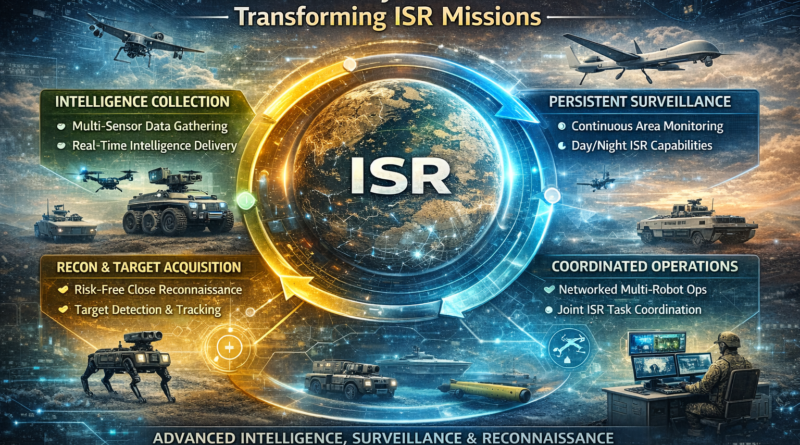
How Military Robots Are Transforming ISR Missions
Introduction
Intelligence, Surveillance, and Reconnaissance (ISR) missions form the foundation of modern military decision-making. Robotic systems have significantly expanded ISR capabilities by enabling persistent, distributed, and risk-reduced data collection.
The Role of Robotics in Modern ISR
Military robots enhance ISR by:
- Extending operational reach
- Reducing human exposure
- Providing persistent situational awareness
ISR robots operate across all domains, integrating sensors, communications, and autonomy.
Aerial ISR Platforms
Unmanned aerial systems dominate ISR operations due to their flexibility and coverage. They support:
- Wide-area surveillance
- Target tracking
- Communications relay
Ground-Based ISR Robots
UGVs equipped with EO/IR sensors are increasingly deployed for:
- Perimeter security
- Urban reconnaissance
- Forward observation
Their low profile enables covert monitoring in complex terrain.
Maritime and Underwater ISR
USVs and UUVs contribute to maritime domain awareness by monitoring shipping lanes, ports, and underwater infrastructure.
Data Fusion and Networked ISR
Robotic ISR systems increasingly operate as part of networked architectures, combining data from multiple platforms into a unified operational picture.
Conclusion
Military robots are not replacing traditional ISR assets but complementing them. By enabling persistent, distributed sensing across domains, robotic ISR systems are reshaping how information is collected and exploited in modern operations.