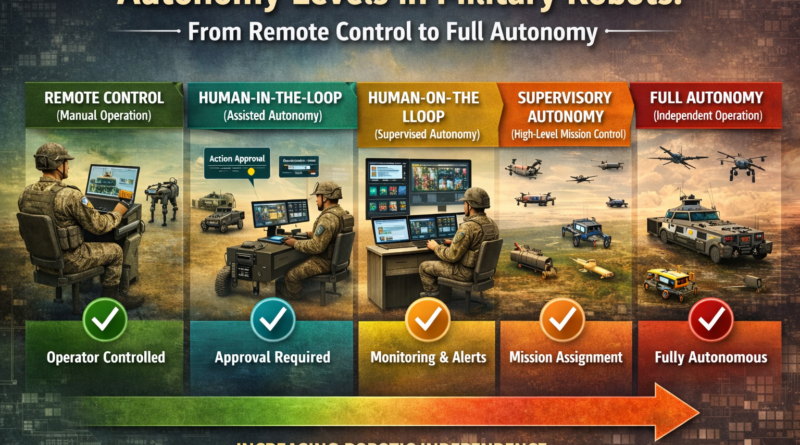
Autonomy Levels in Military Robots: From Remote Control to Full Autonomy
Introduction
Autonomy is one of the most critical—and most debated—aspects of military robotics. While popular discussions often focus on fully autonomous systems, most military robots today operate across a spectrum of autonomy levels.
This article examines how autonomy in military robots is defined, classified, and applied in operational contexts.
Understanding Autonomy in Military Robotics
Autonomy refers to a system’s ability to perform tasks without continuous human input. In military robotics, autonomy is not binary but incremental, balancing machine decision-making with human oversight.
Level 1: Remote Control
At this level, robots are fully controlled by human operators. The system executes commands without independent decision-making.
Advantages:
- High human control
- Lower ethical and legal complexity
Limitations:
- High cognitive load on operators
- Limited scalability
Level 2: Assisted Autonomy
Robots provide support functions such as obstacle avoidance or stabilization while remaining under direct human command.
This level is common in EOD robots and early autonomous ground platforms.
Level 3: Semi-Autonomous Operation
Semi-autonomous systems can execute predefined tasks independently but require human approval for critical decisions.
Examples include:
- Autonomous navigation with human-in-the-loop targeting
- Automated surveillance patrols
Level 4: Supervised Autonomy
At this level, a single operator may supervise multiple robotic systems. Human intervention occurs only when the system encounters uncertainty or predefined triggers.
This model supports scalability while retaining oversight.
Level 5: Full Autonomy
Fully autonomous systems can plan, decide, and execute missions without human intervention. While technically feasible in controlled environments, their use in lethal military applications remains limited and highly regulated.
Operational and Ethical Considerations
Autonomy increases efficiency but raises questions around accountability, reliability, and control—particularly in contested environments.
Most modern military programs emphasize human-in-the-loop or human-on-the-loop approaches.
Conclusion
Autonomy in military robotics is best understood as a spectrum rather than a destination. Current and near-term systems prioritize controlled autonomy that enhances operational effectiveness while maintaining human oversight.