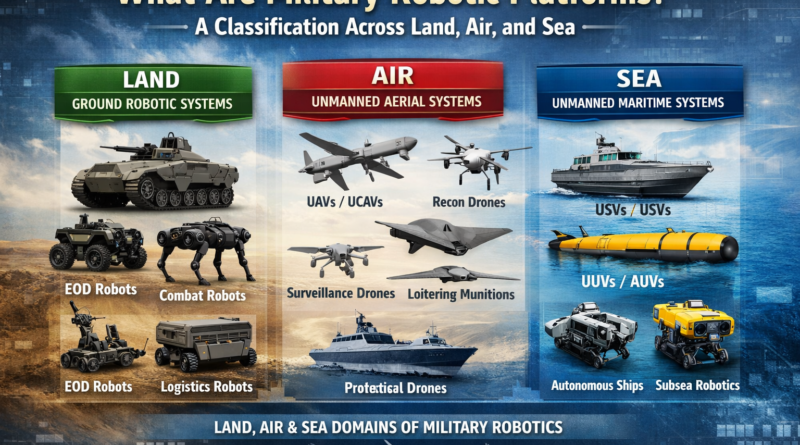
What Are Military Robotic Platforms? A Classification Across Land, Air, and Sea
Introduction
Military robotic platforms have become a core component of modern defense operations. From unmanned ground vehicles supporting logistics and EOD missions to aerial and maritime systems conducting persistent surveillance, robotic platforms are reshaping how military forces operate across domains. Understanding how these platforms are classified—and why those distinctions matter—is essential for assessing current capabilities and future developments.
This article provides a structured overview of military robotic platforms, classified across land, air, surface, and underwater domains, while highlighting their operational roles and design considerations.
What Defines a Military Robotic Platform?
A military robotic platform is an unmanned system designed to perform operational tasks with varying degrees of human control or autonomy. These platforms integrate mobility, power, communications, sensors, and mission payloads into a single system optimized for specific operational environments.
Key defining characteristics include:
- Unmanned operation
- Mission-specific payload integration
- Remote, semi-autonomous, or autonomous control
- Operation in contested or hazardous environments
Land Domain: Unmanned Ground Vehicles (UGVs)
UGVs operate on land and are among the most mature military robotic platforms in service today. They are used in roles such as:
- Explosive ordnance disposal (EOD)
- Logistics and resupply
- Surveillance and reconnaissance
- Combat support and force protection
UGVs are typically categorized by size, mobility (tracked vs wheeled), and payload capacity. Their primary advantage lies in reducing human exposure to risk in complex terrain.
Air Domain: Unmanned Aerial Systems (UAS)
Unmanned aerial platforms provide rapid situational awareness and extended operational reach. Military UAVs range from small tactical drones to long-endurance systems capable of operating at high altitudes.
Common mission roles include:
- Intelligence, surveillance, and reconnaissance (ISR)
- Communications relay
- Target acquisition and support
Endurance, payload weight, and autonomy levels are key design trade-offs in aerial platforms.
Maritime Surface Domain: Unmanned Surface Vehicles (USVs)
USVs operate on the water surface and are increasingly used in naval and coastal operations. Typical missions include:
- Maritime surveillance
- Patrol and force protection
- Mine countermeasures support
Their value lies in persistent presence and reduced risk to crewed vessels, particularly in contested maritime zones.
Underwater Domain: Unmanned Underwater Vehicles (UUVs)
UUVs operate in one of the most challenging environments for robotic systems. They are commonly used for:
- Mine detection and neutralization
- Subsea reconnaissance
- Infrastructure inspection
Navigation, communication, and endurance remain key challenges due to underwater operating constraints.
Multi-Domain and Hybrid Platforms
Emerging platforms are designed to operate across multiple domains or coordinate with other robotic systems. These include:
- Amphibious robotic systems
- Swarm-enabled platforms
- Coordinated land-air robotic teams
Such systems represent a shift toward distributed and networked robotic operations.
Conclusion
Military robotic platforms are not a single category of systems but a diverse ecosystem operating across land, air, surface, and underwater domains. Understanding their classification helps clarify operational roles, capability gaps, and future development priorities.
As autonomy, communications, and payload technologies evolve, the boundaries between these platform categories will continue to blur—reshaping modern military operations.